Cryptanalysis of a Quantum Public Key Encryption Scheme
I explain my cryptanalysis of a public key encryption scheme that uses a four-states quantum public key to encrypt a qubit message. This scheme was described in Zhixin Liu et al 2022 Phys. Scr. 97 045102
Introduction
We’ll first try to understand the scheme described in the paper. As with most public key encryption schemes, there are two keys. A private key to decrypt data. A public key derived from the private key to encrypt data.
The private key ($K_p$) is classical and can take any one of four values. Which means it contains $log_2\ 4 = 2$ bits of information.
$$K_p\in\{k_0,k_1,k_2,k_3\} $$The public key ($K_\theta$) is a qubit prepared in one of four states, the eigenstates of the Pauli $X$ and $Y$ operators
$$|K_\theta\rangle=\tfrac{1}{\sqrt2}\big(|0\rangle+e^{i\theta}|1\rangle\big),\quad \theta\in\{0,\pi,\tfrac{\pi}{2},-\tfrac{\pi}{2}\}\ \leftrightarrow\ \{|+\rangle,|-\rangle,|{P_+}\rangle,|{P_-}\rangle\}$$The public keys are generated from the private keys using these rules:
$$ \begin{array}{c|c|c} \text{Private Key} & \text{Public Key} & \text{Notation} \\ \hline k_0 & \dfrac{1}{\sqrt2}|0\rangle+\dfrac{i}{\sqrt2}|1\rangle & |P_+\rangle \\[1.2ex] k_1 & \dfrac{i}{\sqrt2}|0\rangle+\dfrac{1}{\sqrt2}|1\rangle & |P_-\rangle \\[1.2ex] k_2 & \dfrac{1}{\sqrt2}|0\rangle+\dfrac{1}{\sqrt2}|1\rangle & |+\rangle \\[1.2ex] k_3 & \dfrac{1}{\sqrt2}|0\rangle-\dfrac{1}{\sqrt2}|1\rangle & |-\rangle \end{array} $$The plaintext message is a qubit $|M\rangle=\alpha|0\rangle+\beta|1\rangle$. Here, $|\alpha|^2$ and $|\beta|^2$ give the probabilities of obtaining 0 and 1 respectively after measurement in the computational $Z$ basis and hence $|\alpha|^2 + |\beta|^2=1$.
Encryption.
The CNOT operation is done with public key qubit $|K_\theta\rangle$ as control and message $|M\rangle$ as target. The target is then measured in $Z$ basis and the outcome $m$ is published. The collapsed control wire is shipped as ciphertext $|M_{en}\rangle$.
The paper claims that this scheme is information-theoretically secure, which I show is not true.
The Flaw
First, I’ll express the entire encryption scheme in a simpler way.
Define a matrix $R_\theta$ :
$$R_\theta= \begin{pmatrix} 1&0\\ 0&e^{i\theta} \end{pmatrix}$$This is just a phase rotation operator.
Now, suppose the message is $|M\rangle=\alpha|0\rangle+\beta|1\rangle$. The initial state is
$$|K_\theta\rangle\otimes|M\rangle$$$$= \tfrac{1}{\sqrt2}\big(|0\rangle+e^{i\theta}|1\rangle\big)\otimes \big(\alpha|0\rangle+\beta|1\rangle\big)$$$$= \frac1{\sqrt2} \left( \alpha|00\rangle +\beta|01\rangle +\alpha e^{i\theta}|10\rangle +\beta e^{i\theta}|11\rangle \right)$$Applying $\mathrm{CNOT}$ $|10\rangle\leftrightarrow|11\rangle$
$$\frac1{\sqrt2} \left( \alpha|00\rangle +\beta|01\rangle +\beta e^{i\theta}|10\rangle +\alpha e^{i\theta}|11\rangle \right)$$Now, grouping by the second qubit
$$\frac1{\sqrt2} \left[(\alpha|0\rangle+\beta e^{i\theta}|1\rangle)\otimes|0\rangle + (\beta|0\rangle+\alpha e^{i\theta}|1\rangle)\otimes|1\rangle \right]$$Here, we observe that
$$\alpha|0\rangle+\beta e^{i\theta}|1\rangle = R_\theta|M\rangle$$and
$$\beta|0\rangle+\alpha e^{i\theta}|1\rangle=R_\theta X|M\rangle$$Therefore
$$\boxed{ |K_\theta\rangle\otimes|M\rangle\xrightarrow{\text{CNOT}} \frac1{\sqrt2}\left( R_\theta|M\rangle\otimes|0\rangle + R_\theta X|M\rangle\otimes|1\rangle \right)}$$The protocol then measures the second qubit and publishes the result $m$. If $m=0$
$$|M_{en}\rangle = R_\theta|M\rangle$$if $m=1$
$$|M_{en}\rangle = R_\theta X|M\rangle$$Therefore, generally
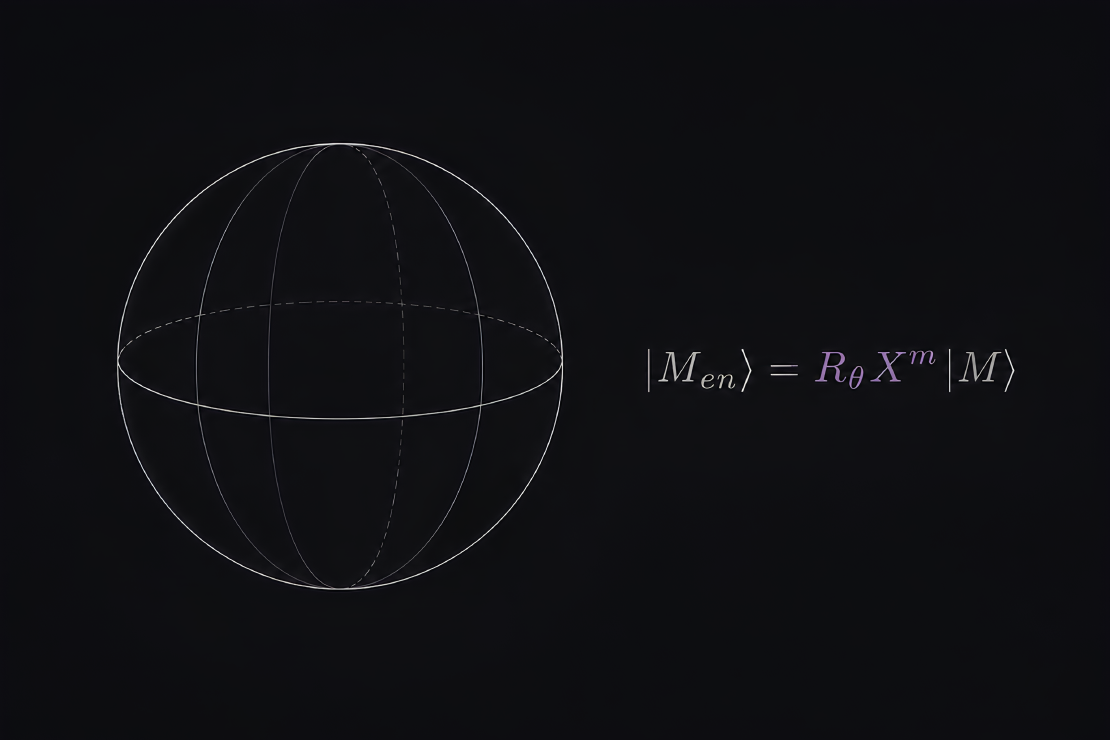
$$\boxed{|M_{en}\rangle = R_\theta X^m|M\rangle}$$Let the plaintext be $$ |M\rangle=\alpha|0\rangle+\beta|1\rangle, $$ and let the ciphertext be generated according to the protocol, with the published measurement outcome $m$. Then the ciphertext uniquely determines the computational-basis probability distribution of the plaintext: $$ \left(|\alpha|^2,\;|\beta|^2\right) $$ Proof. From the previous derivation, we know $$ |M_{en}\rangle=R_\theta X^m|M\rangle. $$ The operator $$ R_\theta= \begin{pmatrix} 1 & 0\\ 0 & e^{i\theta} \end{pmatrix} $$ is diagonal. Therefore it only changes the relative phase of the $|1\rangle$ component, leaving the magnitudes of the amplitudes unchanged. If $m=0$, then $$ |M_{en}\rangle = R_\theta|M\rangle = \alpha|0\rangle+\beta e^{i\theta}|1\rangle. $$ Measuring in the computational $Z$ basis gives $$ P(0)=|\alpha|^2,\qquad P(1)=|\beta|^2. $$ If $m=1$, then $$ |M_{en}\rangle = R_\theta X|M\rangle = \beta|0\rangle+\alpha e^{i\theta}|1\rangle, $$ Measuring in the computational $Z$ basis gives $$ P(0)=|\beta|^2,\qquad P(1)=|\alpha|^2. $$ Since the value of $m$ is published as part of the ciphertext, an adversary knows whether this swap has occurred and can therefore reconstruct the original probability distribution $$ \left(|\alpha|^2,\;|\beta|^2\right). $$ Hence, the computational-basis probability distribution of the plaintext is completely preserved by the ciphertext. $\qquad\blacksquare$
The paper makes the mistake of assuming that measuring the target qubit destroys the plaintext. However, after $\mathrm{CNOT}$, the quantum information of the message lies in the control qubit. Measurement does not destroy the information encoded in the control qubit.
Since the ciphertext uniquely determines the computational-basis probability distribution of the plaintext, an adversary can extract non-trivial information about the message without knowing the private key. An information-theoretically secure encryption scheme must reveal no information whatsoever about the plaintext from the ciphertext alone. This scheme therefore fails to achieve information-theoretic security.
This analysis highlights the value of reducing a protocol to its simplest mathematical form before attempting to reason about its security.
Source
Related Posts

The Cake is a Matrix: A CitadelCTF 2025 Challenge
In this writeup I’ll go through my thought process and solution for the challenge “The Cake is a Matrix,” which was a part of the CitadelCTF 2025 by Cryptonite. This challenge was created by goosbo.
Read more
Privilege Escalation via Buffer Overflow: Case Study on Narnia
In this article, I go over my journey from understanding memory layouts to achieving privilege escalation through a buffer overflow exploit, using OverTheWire Narnia as a case study.
Read more
Understanding Modular Binomials in Cryptography
In this article, I go over a toy model of modular binomials and try to demonstrate how algebraic structure or patterns in a cryptographic system can inherently break secrecy.
Read more